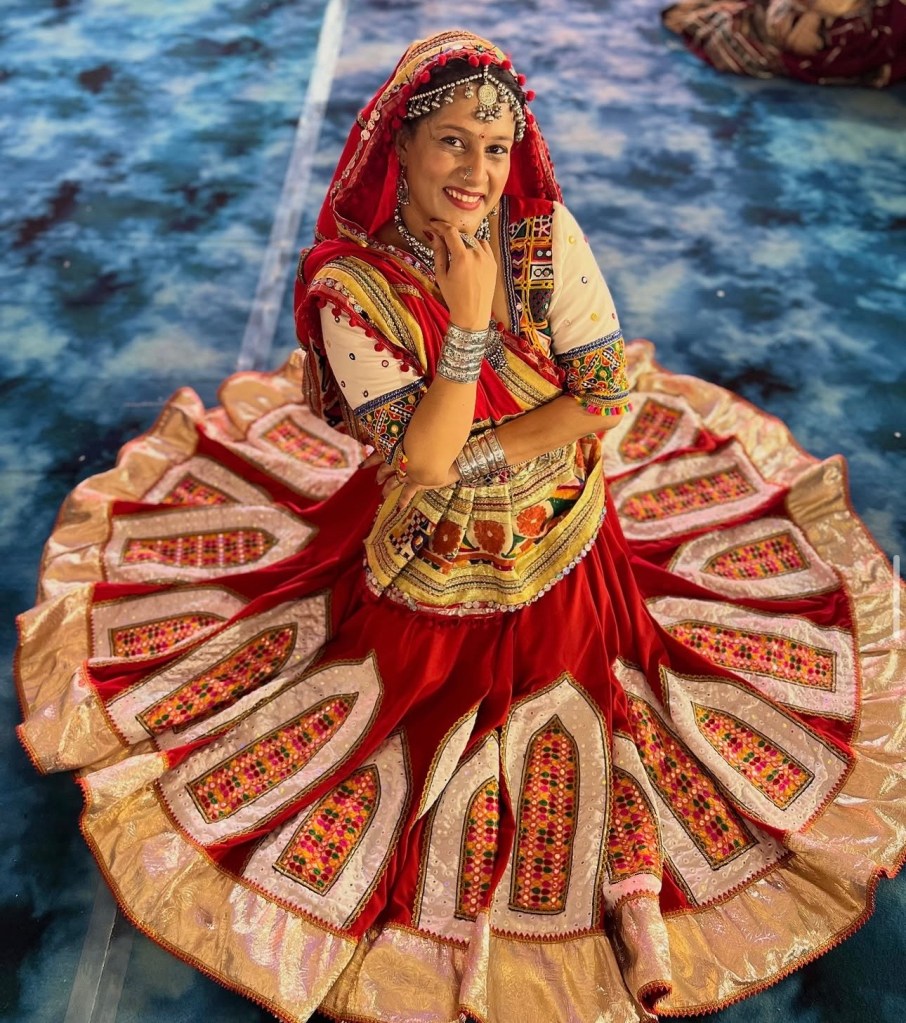
The dhol beats sound like heartbeats against the night air, the ghagra cholis spin, the kadas shine, and the circle grows tighter with each clap. In the center of the circle, Chemmeen does both: dissolves into the crowd while also standing apart. Her feet, adorned with payals, strike the ground rhythmically, her arms paint arcs in the air as she performs dodhiyu, and every step is etched with devotion. She is both a participant and a guide, carrying pure devotion through control in her craft.
“Garba is a prayer in motion,” she expressed. “When I dance, my mind quiets, but my heart is loud and proud. It’s freedom and grounding at once.” For Chemmeen, life revolves around dance, a rhythm she has been immersed in since childhood. Garba is not simply a dance form performed during festivals; it is heritage embroidered with discipline and a way to express joy and devotion that lingers through the body. To dance garba, she insists, is “joining a circle that stretches far beyond classes and events.”
Chemmeen’s earliest memories with garba were during the Navratri celebrations in her building back in Mumbai, India, where everyone would dress up in chaniya cholis, kurtas, kediyas, and accessorise their outfits with pom-pom or silver jewellery to dance and celebrate this festival together. “I remember watching girls twirl in their ghagras, men performing barrels in their kediyas, and kids playing raas perfectly in sync, and I was spellbound,” she mentioned. Her parents, who are avid lovers of Indian culture and cultural performances, saw a spark in her that was worth nurturing.
At the tender age of six, she started formal training in Kathak, an Indian classical dance form. Being one of the most disciplined dance forms, for Chemmeen it wasn’t love at first sight. “I cried before every class, I threw fits, and was always eager for class to end,” Chemmeen recollected. But “my parents refused to relent.” Her mom waited outside each class to reassure and support her, and eventually the discipline took root.
“Looking back, I’m beyond grateful,” she added. “My mother gave me the art, while my father gave me the performance. Together, they made me fall in love with Indian dance.” Her father always took her to cultural performances and “never missed the opportunity” to expose her to them. “I was their world and they were mine.” Her mother’s discipline and unwavering support, and her father’s love for her and for performances, became the foundation of her career.
From a student to a teacher, the transformation was nothing short of magical and began in middle school. In the eighth grade, Chemmeen was the only student selected to perform alongside 10th graders, an honour that was overwhelming yet thrilling. “The 10th graders were the people I always looked up to in school, and then performing with them—I can never put that feeling into words. I was a bit nervous but excited too,” she added. When the older students were struggling with the steps and choreography, “they couldn’t remember the steps or had problems executing them, I would step in and assist them,” Chemmeen added proudly.
“That was the first time I realised what teaching felt like. When you simply break down and simplify a step for someone and they finally get it, the joy on their face is unparalleled. That feeling is so, so addictive,” she emotionally recollected. From that moment, her friends and family began to ask her for guidance in dance for shows, training, and more. Eventually, this passion moulded her career, and she became the person everyone looked up to. Students from her dance academy would be tickled pink when they got to know that Chemmeen would be teaching them on a particular day. However, for Chemmeen, teaching was never part of her blueprint. “It wasn’t intentional; teaching just became a calling,” she admitted.
Now, as an experienced instructor, Chemmeen carries her philosophy in one line: “Honour the roots but let the branches grow.” In dance, this means preserving tradition while also making room for experimentation and exploration. She is more concerned with authenticity than accuracy. “A good dancer isn’t the one who has the flashiest moves; it’s the one whose energy can be felt, whose joy radiates, and whose devotion screams across the space. When you dance with the music, not to it, that’s when you shine.” The perfect balance of reverence and innovation has become her hallmark. She pushes her students to remember that steps are merely the vessel, but the joy and devotion should come from within.
Just like any Indian tradition, garba has been reshaped by time. The beats were once like raindrops but have now changed into a storm. Bollywood remixes have reshaped traditional music and pump through the speakers that were once reserved solely for folk tunes and melodies. Costumes have transformed from Ajrak and Bandhani patterns to brighter, flashier ensembles tailored for Instagram feeds.
While Chemmeen embraces parts of this change, particularly the way garba has spread across the world, “be it a small circle in Gujarat to Mumbai and now to multiple grounds in New York, the devotion is the same,” she elaborated. When thousands of people clap, spin, and dance to the same beat, it feels like a heartbeat. “The energy gives me goosebumps,” she reflected.
Yet she is upset by the “trendification of garba.” It saddens Chemmeen to see that “people see garba as a medium to win prizes, or impress their friends, or just dance because some find it cool,” because garba wasn’t invented for pleasure or selfishness. It was born solely of devotion and as a medium of worship, and “that’s what should keep it alive and should be the reason people perform garba,” Chemmeen added sternly.
Chemmeen’s strongest conviction lies in her insistence that garba must be done barefoot. “You wouldn’t walk into a temple with shoes, so why do garba with sandals or shoes? You either do it barefoot or don’t do it at all,” Chemmeen added firmly. For her, it’s not nitpicking; it’s a matter of respect and serves as a reminder that garba is, first and foremost, an act of worship.
In her classes, Chemmeen’s lessons are more than just dance—they extend beyond it. She “wants her students to leave with confidence, the kind of confidence that lets them hold their heads high, not just in garba but in life too. Joy and happiness are also central.” She also expressed that “the spark that students feel when they’re dancing should be the one that they carry with them even on the darkest days.”
Furthermore, she hopes that every student feels freedom—the freedom to let go of fear, judgement, and self-doubt. “When you dance with your heart, it shows everywhere. It reflects in how you live, love, and move through the world.”
Garba, by its nature, moves in a circle around a lamp or idol, which serves as a symbol of respect for divine energy. For Chemmeen, that circle is both a ritual and a metaphor. Garba is a form of worship and self-expression because what matters is the connection with divine energy, the people around you, and the joy of connecting with your inner self.
From her childhood Navratri nights to her strict Kathak training, from her first teaching moment in eighth grade to the students she now guides and inspires, each turn of the circle is another reaffirmation that garba remains alive—not because of competitions or the dazzle of social media, but because in every heartbeat it holds devotion.
 Devotion Through Motion
Leave a comment